Feeds:
Posts
Comments

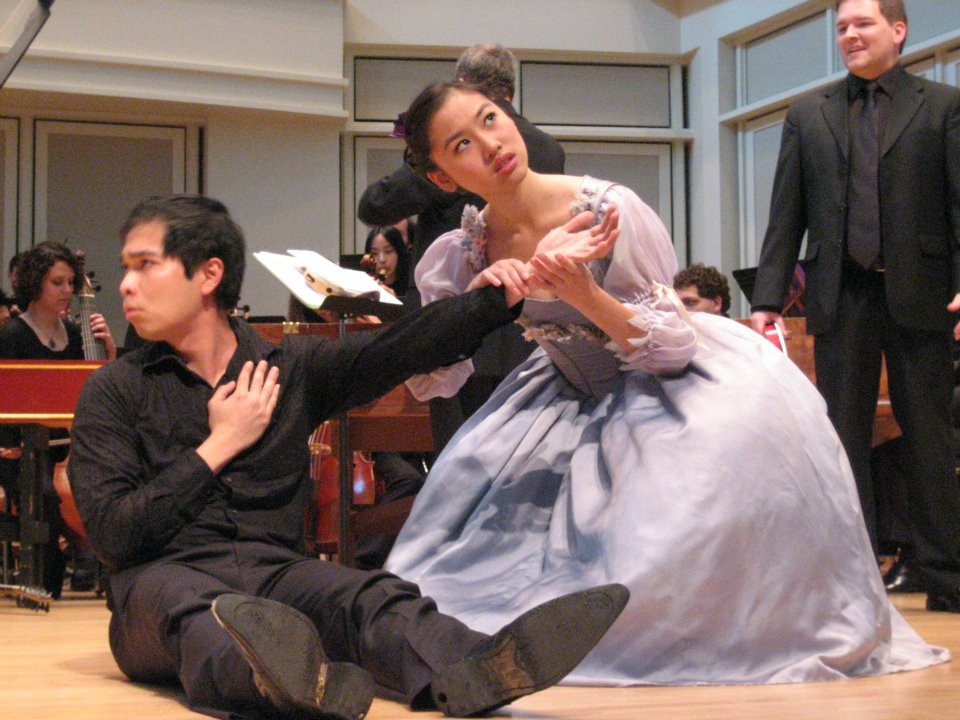
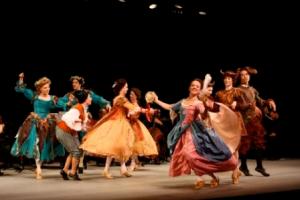
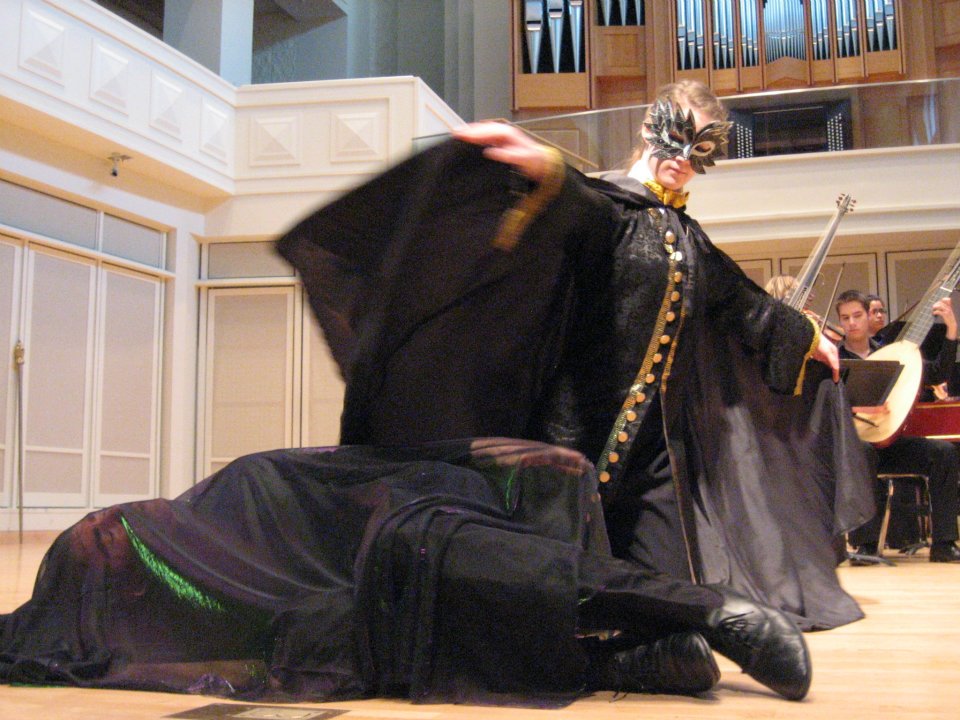
Catherine Turocy was the co-director and choreographer for an interdisciplinary project at Indiana University which resulted in two performances of “Lully, Glory Without Love?”  Mace Perlman, co-director and author of the spoken dialogue, performed in the production, drawing from his gifts as actor and mime.  Conceived by Allison Calhoun and conducted by Nigel North, the project was a huge success.  Catherine is grateful to Sarah Edgar for assisting her in teaching and coaching the dancers from the Ballet Department who donned Baroque costumes for the first time and performed in both noble and grotesque dances.  Here is the review link with the complete names of the artists: http://blogs.music.indiana.edu/choral/2012/04/25/review-baroque-orchestra-pro-arte-singers-dancers-magically-tell-lullys-story/

photos taken by Sung Lee

The Early Dance Institute

” As a young student at The Ohio State University in the 1970’s I dreamed of what the early dance field would be in decades to come.  Here are my current thoughts.  I welcome your feedback – it takes more than one person to make this dream a reality. Feel free to post comments on this blog or to send a letter of support emailed to cturocy@gmail.com  ”  Catherine Turocy

Brief Description: The Early Dance Institute would provide a comprehensive program in the study of historical dance performance before 1900,  supplementing performance with research and theoretical studies, leading to degrees at the graduate level. The faculty would consist of internationally known performers and dance historians who specialize in the performance of early repertory. The EDI would include university-wide academic support from disciplines as diverse as musicology, computer studies, literature, medieval studies, and fine arts.

EDI would be a unique environment of research and experimentation that does not exist anywhere else in the world. Here, students could delve deeply into the sources of dance from the 15th-early 19th century, and would eventually be able to independently reconstruct dances as well as use their knowledge for new, contemporary creations rooted in the principles of historic performance practice.  While classes in early dance that include technique and discussions of period sources exist in a handful of other universities (Université de Nice inFrance and the Danshögskolan inSweden), they are not comprehensive focuses of study, but rather elements of a well-rounded dance education. Most professional dancers working in period styles in Europe expand their knowledge by taking workshops, working on their own, or learning by performing in various short-term projects. The Early Dance Institute would be the only place where students can fully concentrate on early dance and its application in today’s dance world. This extended period of study outside of the pressures of the current dance scene leads to a more profound depth of knowledge that engender exciting experimentations, fresh ideas about reconstructing dances from period sources, and insights into creating new dances in period styles.

Uniqueness of Program: Programs such as EDI are very current in music departments across the country and in Europe. Art History and Theater History programs also exist on the graduate level. The University of California at Riverside at one time carried a Dance History program on the graduate level, but has since changed its focus to world culture. The Early Dance Institute as described in this proposal would be a unique program, drawing international interest from around the globe.  This would bring a new era in dance studies and their practical application to dance performance.

The program would include lessons in Western period dance technique with extensive solo and ensemble performance opportunities.  The program would offer academic courses designed to provide an understanding of the many practical and theoretical areas essential to performance of medieval, renaissance, baroque, and classical dance (e.g. improvisation, ornamentation, articulation, period movement and gesture, mask work, costume design, historical stage direction, historical notation, bibliography, dance theory, etc.). Research would be encouraged, and opportunities for research provided both in academic courses and in elective special projects. The faculty of the Early Dance Institute would make every effort to accommodate a student’s specialized interests without losing sight of a broader commitment to artistic excellence and scholarship.

The student body would be comprised of graduate students and a smaller number of undergraduate students minoring in early dance from the culturally diverse student population. In addition, all activities of the EDI would be available to the approximately  200 dance students majoring in standard practice areas.

Practical Questions

Which classes would be offered/required?

1. Foreign language: choice of French, Italian, German, Spanish, Russian

2. Historical Dance Technique as the daily 2 hour technique class. We could offer a different period each semester.  Perhaps it should also be at a different time than the ballet and modern technique, so that they could take those classes in addition.

We could offer a separate, more “survey” course for the minors and non-early dance students in the afternoon.

3. Dance Observation and Writing connected with an investigation of period sources

4. Historical Dance Analysis including cultural perspectives

5. Musical Score Reading from different periods

6. Historical Dance Theory and its application in period repertoire

7. Dance Composition (historical choreographic conventions and how those conventions can, or are, still used today. Choreographing in a period style)

8. Reconstruction and Interpretation of Historical Notations/Texts

9. Repertory Performance

How does the NYBDC interact with the program?

Answer: Teaching technique, composition, notation, early dance repertoire.  Acting as advisors.  Inviting student dancers to join us in summer projects in European festivals.  Working individually with students in applying dance theory to practice in an experimental fashion…this could be a neo-historical effort or an effort to further define a historical style by deepening approaches of “authenticity.”  Also, after graduating, for those dancers who wish to continue performing on the stage, we could definitely help to place them in our company or another company they might be interested in.

Additional Thoughts:

I think we could make this work in the Midwest.  With so many early music programs and dance programs at Oberlin College,  Indiana University, Case Western Reserve, Ohio State University and Denison University, a production could be created with students where the production would tour the different universities but the student performers would change, depending upon the needs and strengths of the particular university. This would allow the different institutions to join resources to support period theatrical productions in which their students would gain valuable experience and the early dance and music fields would benefit  by seeing productions which are too big for the smaller professional companies to produce. The NYBDC dancers could enhance the educational experience by participating in weekend residencies with the various university departments, preparing the students as needed.

Theater projects would also be very exciting to do.  We could alternate music and theater if we want.

We could also collaborate with the Art Department, local Museums, local historical sites and interact with the community on historical projects which would have a dance component.

The performance element of EDI is important.  Combining theory and practice is very important to me and important to furthering the field of dance history.
Breaking News!

Our March 11 performance at Cornell University was a success!  Pictured above are Carly Fox and Olsi Gjeci in Campra’s L’Espagne. Here is a link to the review: http://cornellsun.com/section/arts/content/2012/03/14/afternoon-opera

Cornell University has also posted a short video clip of the dress rehearsal ending with the Minuet for the Amazons, always a favorite! http://www.cornell.edu/video/?videoID=1964&utm_source=chronicle_weekly_enews&utm_medium=email&utm_campaign=1964

Deadline for registration for the Santa Barbara Historical Dance Weekend has been extended to March 20th for those students securing dorm rooms.  If you are not staying in the dorm your deadline is May 1, 2012. Here is a video clip from Mariel McEwen who recorded Catherine’s class at UC Santa Barbara last November: http://vimeo.com/38406982

Only a month ago we were in Le Touquet for the festival. Olsi Gjeci captured a typical scene in the town:


Courtlyn Hanson took this wonderful photo of our performance at Southern Methodist University where young dancers joined the company and danced Mr. Priest’s Minuet.

“Les Voyages de l’Amour: Operatic Flights from 18th-Century France” features “Les Sauvages” from Rameau’s Les Indes galantes, and “L’Espagne” from Campra’s L’Europe galante. A collaboration between Les Petits Violons; Mathieu Langlois, director, the Cornell Chamber Orchestra; Chris Younghoon Kim, conductor, and the New York Baroque Dance Company; Catherine Turocy, director and choreographer, with guest vocalists Paul Shipper, Owen McIntosh, Ross Hauck, and Rebecca Choate Beasley. Funded, in part, by grants from the National Endowment for the Arts, the French Studies Program, and the Cornell Council for the Arts, as well as the Institute for European Studies, Society for the Humanities, Department of Romance Studies, Cornell University Library, and the Department of Theatre, Film and Dance. Admission: $15 general, $8 students, available at http://.baileytickets.com, Ticket Center Ithaca, and at the door. A pre-concert lecture at 2 PM will present seldom-seen images from Cornell’s rare book collection.

Don’t miss the Radio Interview with Catherine Turocy and James Richman on WRR-FM (101.1) Art Matters!!!

The interview will be part of the WRR-FM (101.1) Art Matters broadcasts of Sunday, Feb. 5 (5:30 pm) and Thursday, Feb. 9 (6:30 pm) after which it can be heard via podcast:  wrr101.com

Our Next Concert:

Chamber Music and Dance from Versailles and London

Sarah Edgar, Dancer, photo by Jacqueline Chambord


Sunday, 12 February 2012, 7pm at SMU Caruth Auditorium call 1-800-494-8497 for tickets or visit www.dalasbach.org


Sunday, February 12th at 7pm: Fly to Dallas for a Pre-Valentine’s Day Treat and see Chamber Music and Dance from Versailles and London.


Link for more information and tickets: http://dallasbach.org/concerts/Chamber-Music-Dance

Location:  Caruth Auditorium at SMU

The Dallas Bach Society, directed by James Richman, and The New York Baroque Dance Company, directed by Catherine Turocy, will present works from the courts of Louis XIV and XV in France and Queen Anne and George I in England.

To open the program there will be a presentation of Mr. Priest’s Minuet by 12 young dancers selected from a public audition in the Dallas Metroplex.  They have attended a workshop offered by Ms.Turocy and hosted by the School of Contemporary Ballet Dallas which covered period dance notation, court etiquette and the minuet. Dancing Master, Josiah Priest (or Preist as his name was sometimes spelled) and his wife, Frances, directed an academy for young ladies at Gorge’s House in Chelsea.

This will be followed by Mr. Shirley’s Minuet for six dancers performed by the company.  Both minuets are from the same collection of dances used in the education of young girls at boarding schools in 18th century in England and in the colonies. The Diana created by Mr. Siris for the first Lady Diana Spencer when she was only 14 years of age and The Camillafollowed by Le Carillon d’Oxfort (an English country dance published as a French contredanse in Paris in 1706) will complete the first set of dances.

The French theater dance set begins with L’Entrée d’Apolon. Louis XIV, known as the Sun King, took the role of Apollo when he performed in court ballets.  The dance music is from 1681 and the notation was published in 1700 so it is probable that Louis XIV did not dance this specific work; however, it is a virtuosic solo worthy of a king’s admiration. The Chaconne de Phaeton and a Venetian gigue complete this set.

The French Opera-Ballet Project funded by the National Endowment for the Arts makes it possible to present dance excerpts from Jean Philippe Rameau’s Les Fêtes de Ramire.  The concert will close with the very popular and famous Les Folies d’Espagne.

  The NYBDC dancers include Catherine Turocy, Carly Fox, Glenda Norcross, Meggi Sweeney Smith, Junichi Fukuda, Olsi Gjeci and Gregory Youdan.    

This concert will be repeated on February 17, 2012 in Le Touquet, France

  Le Touquet, founded in 1912 and celebrating their 100th anniversary, has invited us to perform this same program with James Richman, conductor.  Follow this link for details:

 http://www.lesmalinsplaisirs.com/Les-Malins-Plaisirs.php?page=programme&NB=Jour1


The New York Baroque Dance Company and Concert Royal in APAP Showcase January 7, 2012

photo: Julie Lemberger

Come to a gala showcase featuring 6 of the finest world-class early music ensembles, produced by GEMS Live! We will be last on the program dancing The Diana, Gigue pour Femme and Les Folies d’Espagne with dancers Carly Fox, Alexis Silver, Meggi Sweeney Smith, Catherine Turocy, Justin Coates, Olsi Gjeci and Gregory Youdan

Suggested donation at the door is $5. No tickets required — Come early for the best seats

DATE: Saturday, January 7, 2012

TIME: 7:00 – 10:00 pm

PLACE: Fifth Avenue Presbyterian Church (Chapel)

7 West 55th Street

http://gemsny.org/apapshowcase2012.html  Click Link to see the other exciting groups sharing this 3 hour program of early music and dance.


DANCE OF THE MONTH: January 7th with Catherine Turocy,  Le Menuet Rondeau d’Omphale

Join Catherine Turocy earlier in the day from 3-4:30pm at Mark Morris Dance Center in Brooklyn on 3 Lafayette Avenue (corner of Flatbush).  The Minuet class  will be accompanied on flute by Elaine Camin.  The basic minuet step with variations will be taught. The class will learn the first figure of a Minuet from Omphale, a five act opera by Andre Cardinal Destouches.  Ms. Turocy will also speak about the changes in the minuet from the beginning to the end of the 18th century. This is a general class for all levels of experience and is of interest to dance, music, drama and art enthusiasts and practitioners.  Classes are only $14 and you are not required to register in advance.


Dance Audition/Workshop
Girls 9-13 years of age
Audition Date: Sunday, January 29 from 3-5pm
Place: Contemporary Ballet Dallas School
1902 Abrams Parkway, Dallas, TX 75214
214.821.2066, email: admin2@schoolofcbd.com
Audition fee: $15
Workshop Feb. 4-5-11 from 3-5pm is free
Pre-registration is encouraged

The New York Baroque Dance Company is looking for 12 young dancers,  between the ages of 9 and 13, to perform Mr. Preist’s Minuet, originally created for a girl’s school outside of London circa 1711.  The performance is with the Dallas Bach Society at Caruth Auditorium, February 12, 2011 at 7pm.  Prior ballet training is essential.  The twelve dancers selected from the audition will learn  the minuet in a 3 day free workshop held at the Contemporary Ballet Dallas School and taught by Catherine Turocy.  The workshop, in addition to teaching the dance to be performed, will include an introductory lesson in reading Feuillet dance notation and a lesson in proper court etiquette at the time of the first Lady Diana, ancestor of today’s Prince William and Prince Harry.

The Dancing Master, Josiah Priest, or Preist as his name was sometimes spelled, and his wife, Frances,  directed an academy for young ladies at Gorge’s House in Chelsea.  According to Jennifer Thorp, we are not certain this is the same Priest, but there is documentation  of a performer in London  by the name of Priest who is sometimes connected with the Stuart Court, “for in April 1673 a dancer named Isaac was one of several dancers (along with Mr. Priest) who performed as Venetians, a Spaniard, a Conjuror, Devils, and Shepherds, in a masquerade for King Charles II’s illegitimate son, the Duke of Monmouth (see Fig. 1). Mr. Isaac received ‘A Rich flowerd Venetian suite with all furnitures’ costing £28 17s 6d, and ‘A Spanish habitt’ costing £8 6s 2d, and either he or another Mr. Isaac and three others (Messrs Priest, Hazzard and Laine) each received a ‘bask habitt’, at 11 guineas per outfit. Two years later, in February 1675, Mr. Isaac was paid for his part in the Whitehall production of the masque Calisto, in which members of the royal family and the court performed alongside French and English professional dancers. Although he never held an official post at Court, it is known that he taught Princess Anne…”  Please visit this site for the sale of the Dance Journal Research issue which contains this fascinating article by Thorp: http://muse.jhu.edu/journals/dar/summary/v024/24.2thorp.html.

This free workshop offers an extraordinary opportunity to delve into the beginnings of ballet and to be introduced to the social connections at court which helped to support and develop the art form. The performing experience in joining The New York Baroque Dance Company on stage as a prelude to their concert with the Dallas Bach Society, Chamber Music and Dance from Versailles and London, will be a unique event in any child’s education as a young dancer.

Click to find information on the  Santa Barbara Historical Dance Weekend

Dancing the Jig is the solution, not a tighter corset!


The Jig is energetic and was popular in balls of the 18th century.  It may be the secret behind the phrase, “Fit as a Fiddle” … The fiddle was the instrument most associated with the jig or gigue -French , or giga, Italian- it was also a medieval name for a bowed instrument-geige- which is where the German word for violin is derived.

Meggi Sweeney Smith will teach the jig and Bach’s gigue on Saturday, December 3rd, from 3-4:30pm, accompanied by live music.  Class fee is only $14. The location is the Mark Morris Dance Center in Brooklyn at 3 Lafayette Avenue.  http://markmorrisdancegroup.org/contact/directions