Dear Dancers,
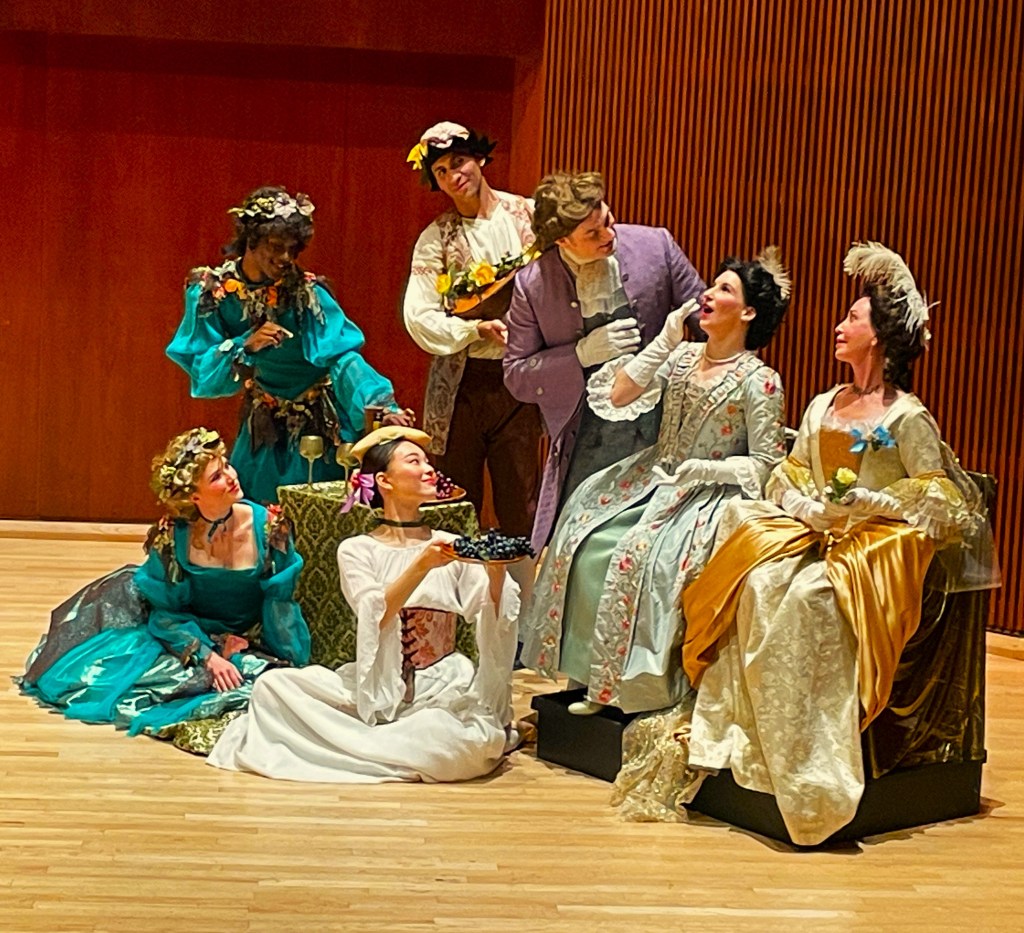
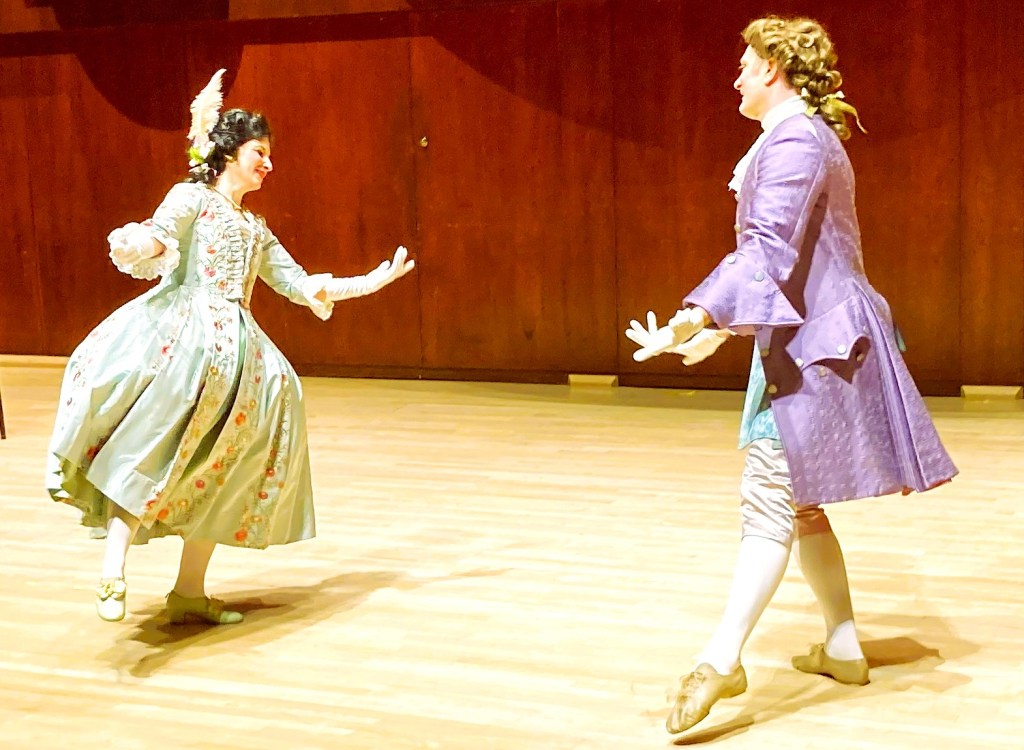
What a pleasure it was to see you perform on March 14th in Dallas, Nicolas Bernier’s Apollon, Comus et La Nuit. The work was unstaged, but then staged and choreographed once the dancers made their entrance. An audience member said he was enjoying the concert and, unexpectedly, it transformed into a ballet! From the first appearance of the court dancers, Alexis Silver and Brynt Beitman and the Duchesse du Maine, Glenda Norcross, the stage was filled with a noble presence. Reminding us of ballet’s beginnings, we saw the perfect carriage of the body joining the earth to the heavens, not stiff, but elongated and proportionately filling the kinesphere around each dancer. The solo Gravement danced by Brynt represented the virtuosic male solos of the time and was performed with vigor and detail. Alexis brought the female counterpart to the male virtuosity, displaying a delicate use of the arms, a polite façade with hints of passion in her demeanor and a graceful intelligence in her footwork. Glenda had a non-dancing role, but it could only be inhabited by a fine dancer emanating grace and beauty. You all helped to set the context of the drama, an entertainment for the Duchesse who never slept!
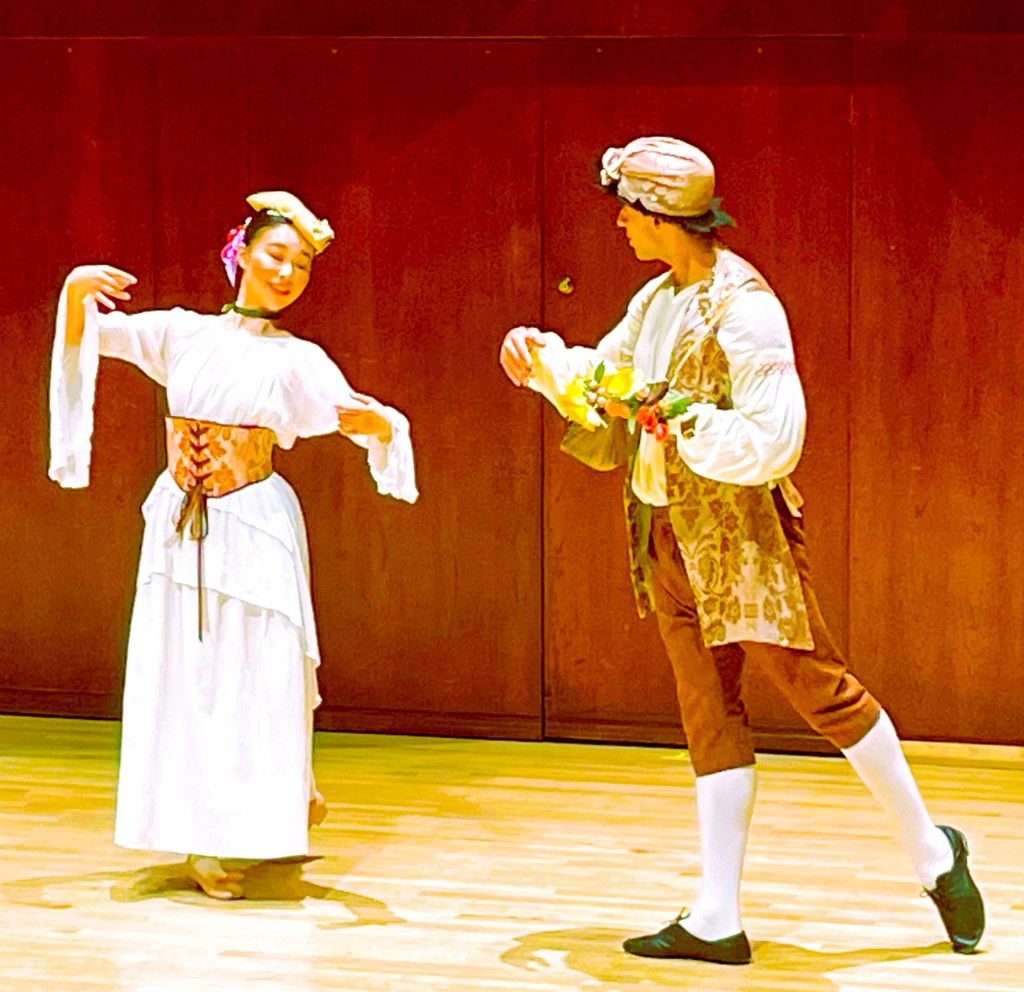
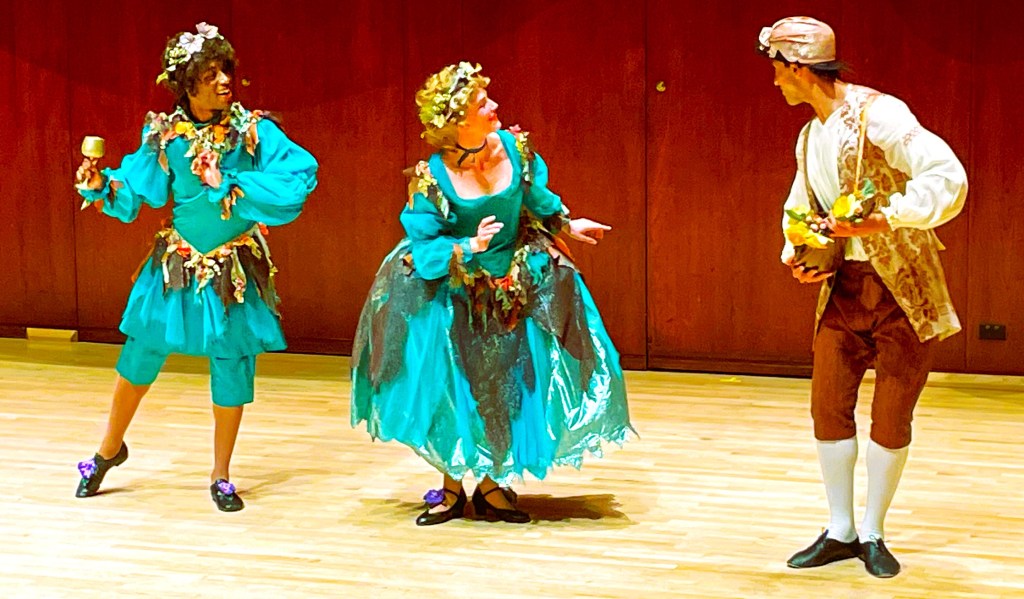
The entrance of the Arcadian shepherdess and shepherd, Kaede Hibara and Facundo Ferreyra, followed by rather inebriated friends of Bacchus, Julia Bengtsson and Patrick Pride, brought two contrasting elements together which are always present in a good ballet: Harmony versus Chaos. A member of the musicians said one only had to see Kaede take her place for the beginning of the Sarabande to know we were entering a Utopian world of nature and harmony. Facundo’s clever dance mixing folk steps, playing the mandolin and executing entrechat quatre was a precursor to character variations in ballet. He immediately hinted there would be a pursuit of the heart as he danced for both the audience and Kaede.
Patrick Pride and Julia Bengtsson would have pleased any fans of the Grotesque style or Commedia dell‘ Arte. Special skills such as musicality, rhythmic percussion, ease in dancing off balance and a deep love of zany characters are a “must” for dancers in this role. This type of dancing is rarely seen on the contemporary ballet stages of today and was a true surprise and delight to the audience. One member of the audience commented on Patrick’s unbounded sense of joy and whimsy. Another audience member mentioned Julia’s cartoon-like role with the innocence of a child crossed with the mischievous insistence of a leprechaun.
The choreography followed ballet theory of the time. After the fun and games were over the Arcadian shepherdess performed a solo musette, restoring order and classical beauty to the stage. This was followed by a tender musette minuet for the Arcadian couple which never ended as the couple held hands and continued walking in an intimate circle as if in a dream. The final trio chorus began and it was Julia who had to touch them to break their spell and join the other dancers in a minuet inspired by Mr. Shirley’s Minuet for Six dancers. The geometrical group minuets of the period typically referred to cosmic theory with the dance of the planets and indeed, the audience felt a sense of completion. One audience member asked, “When is the next performance?” With two curtain calls and a standing ovation, we hope the answer is, “soon!”
Looking through the decades to when I choreographed this work in 1987 and performed it at NYU, and then Florence Gould Hall in 1988, I still see the original cast of dancers imprinting physical stamps on their dance characters. Luisa Meshekoff was the dance double of La Nuit and Ken Pierce was the dance double for Apollo. It was a courting rivalry which expressed their chemistry together and remains in the dances today. The comic timing and wit of James Martin as the original mandolin playing shepherd (thank you Alan Jones for the mandolin!) had a “rock star guitar playing” quality echoed by Roberto Lara who added his own sense of precision to the foot work in 2019. It seemed as if Facundo was able to blend these two qualities in his own performance. Miriam Cooper was the original shepherdess. I always admired her perfect ease and calm in pirouettes and for the musette she had a 3-measure pirouette with rises and a suspended flow. When Caroline Copeland danced this role in 2019 I completely changed the choreography to suit her strong points and again, this year, I created a new choreography for Kaede but I kept Miriam’s pirouette and the sustained flow of Caroline’s performance style. Kaede mastered both and added her own delicate grace. The followers of Bacchus in the original production were Thomas Baird, Patricia Beaman and a third character danced by Renouard Gee. The choreography has not changed a lot but it was changed from 3 dancers to two. The hemiola rhythms played with the same metal goblets, but different wooden plates, are a challenge. Fortunately, all 3 casts had a comic style of their own which truly shines in this choreography. Matthew Ting (2019) added a hemiola walk which I have kept. Julia and Patrick took naturally to these roles and I have been able to embellish the chaos thanks to their talents.
In conclusion, the choreography is affected by who is dancing the role. With each iteration of the ballet through the decades, it is already rich, but is further enhanced by the new performers. With each generation, the choreography gains another facet.
Observing this process over and over again since 1976, a half century, it has been a gift for me as a choreographer to witness what legacy means and to understand the legacy of embodiment as each dancer adds a quality or a step or a glance to the character they are playing…bringing even more grace, beauty and truth to the ballet.
James Richman, harpsichordist and conductor as well as the Music Director for the NYBDC over these 50 years, has enriched my knowledge of the French Baroque style. He directed our last performance with musicians from the Dallas Bach Society led by concert mistress Clare Cason. Matthieu Peyregne sang Apollo, Andrew Dittman sang Comus and Haley Sicking was La Nuit, all inspiring artists and we were honored to have them in the March 14th show. And last, but not least, a big thankyou to our new co-director, Julia Bengtsson, who helped to coach the new dancers!
Thank you to all!
Catherine Turocy
Photos compliments of Marci Hall

 The New York Baroque Dance Co.
You must be logged in to post a comment.