Feeds:
Posts
Comments

Posts Tagged ‘english’

 by Alan Jones

In 2024, Julia Bengtsson and I collaborated on a stimulating project for The New York Baroque Dance Company, centered on dances to music by Francis Johnson performed in the United States in the 1820s. We decided to continue our work in this vein as we reunited in Paris this past February to present our work for the Centre National de la Danse (CND), which made the Johnson project possible. 

As I have been immersed for some time in research on different national dances, I was particularly curious about exploring Cossack dance, which was widely taught in dancing schools of the United States. Slavic dances were first applauded on the American stage during George Washington’s presidency, notably a Pas Russe performed in Philadelphia and Baltimore in the 1790s by James and Lucy Byrne, formerly of Covent Garden. The Pas Russe was soon eclipsed by the Cossack Dance, which naturally appealed to American audiences because of the Cossacks’ fierce attachment to independence and freedom. One of the most important interpretations of a Cossack Dance took place in New York in 1805, by Louise Gervais  Gervais article) and Charles Berault, both French dance teachers. Their duet was apparently derived from the Scythian Dance from Gluck’s Iphigénie en Tauride. Not long after, Gervais and Berault jointly released a collection of dances with music selected by Mr. Berault and dance figures by Miss Gervais. This work is important as the first example of choreography published by a woman in the United States, but the two chose to limit themselves mainly to simple cotillions, and so the choreography of their Cossack Dance was lost. 

A rich selection of choreographic sources nevertheless has been preserved at the library of the Paris Opera and other international archives. All these sources present interesting artistic possibilities as well as logistic challenges, and I ultimately opted to study all of them and to create an original piece of historically informed choreography, rather than a reconstruction of any one dance. Our plan was to rehearse while we prepared for our presentation at the CND, which meant that I would not have the luxury of experimenting, but that I would need to have a dance nearly complete before Julia’s arrival in Paris. For music, my choice fell upon an anonymous Cossack Dance published in Baltimore in the early 1800s, which I had already worked on with the Mexican ensemble Concierto Barroco, for a zoom workshop with the NYBDC.
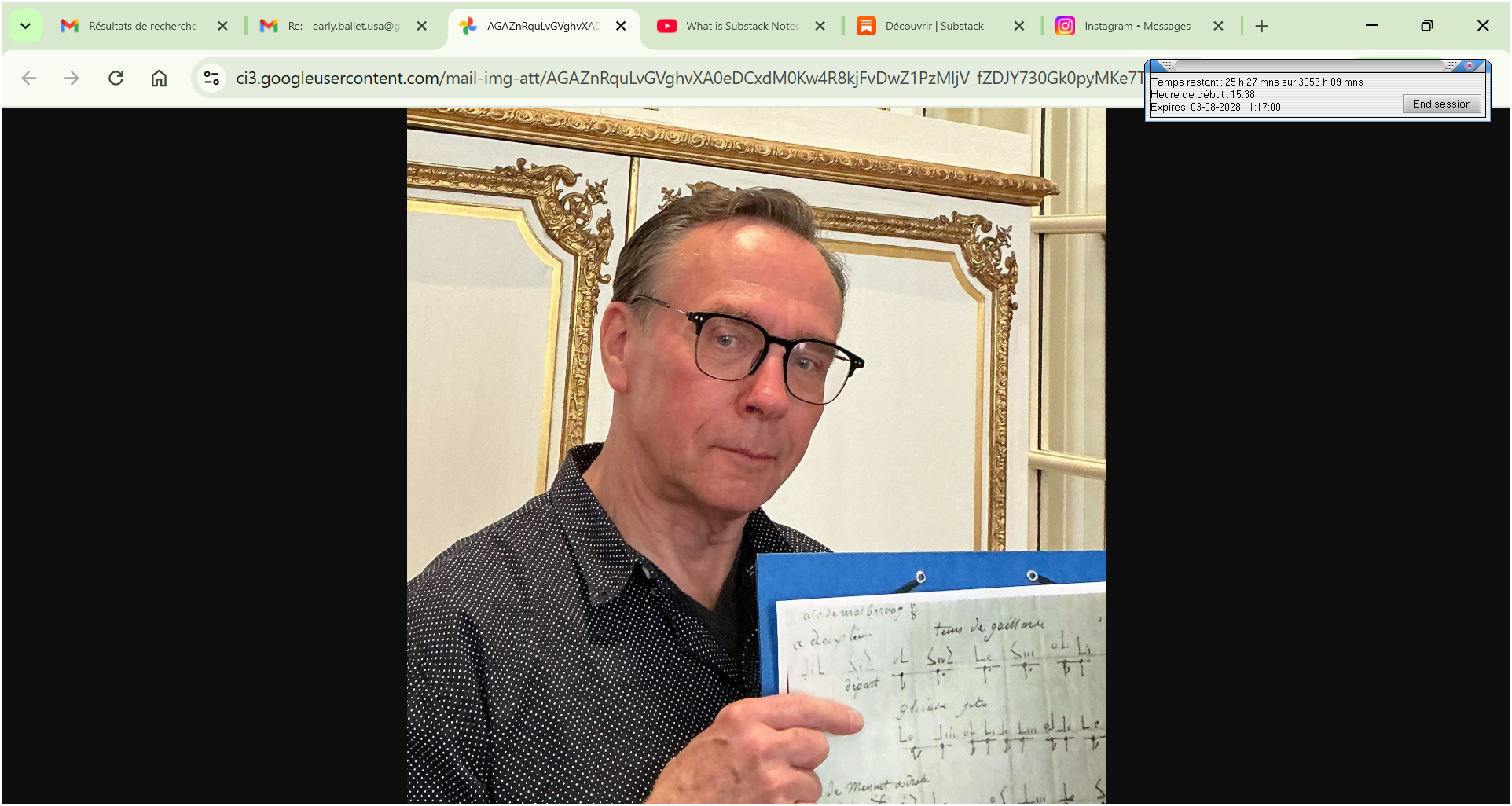
Of the different sources at my disposal, I worked most closely with the notebooks of Michel Saint-Léon, now preserved at the Paris Opera. Saint-Léon wrote down two Cossack dances about 1830, while serving as dancing master to the court of Würtemberg in southwestern Germany. Of the material offered by one duet, I retained bows following the form of the minuet, but adapted stylistically for Americans’ idea of dancing Cossacks. Just as in the minuet, the two dancers split off into opposite corners. One girl does a step very distantly based on male prisiadka technique, alternating demi-pliés with pointings of one foot forward, while the other does eight pas de basque forward. I developed this into a repeating motif, which continues with other elements of Saint-Léon’s instruction, including a hand hold borrowed from the allemande. Photographs of Ukrainian dancers from the early twentieth century interestingly recall some of the engravings familiar from the two main Parisian handbooks on the allemande, by Guillaume and Dubois. It is also curious that the spatial paths of Saint-Léon’s dance frequently correspond to a Cossack Dance from the mysterious “Dance Book TB 1826,” now preserved in Wellington, New Zealand. 

Another useful source proved to be the manuscript of Terpsichorographie, a treatise planned circa 1815 by Jean-Etienne Despréaux, former dancer of the Paris Opera who was then an inspecteur of the School of Dance. Two fragmentary Cossack dances in the manuscript were probably intended for pupils of the Opera school. Using his own notation system, which employs letters of the alphabet read from left to right, Despréaux indicates steps executed by a single dancer whose gender is not indicated. From this source I exploited an opening stamping sequence, rendered in different ways in the two examples, as well as a combination in which the dancer strikes the floor alternatively with heel and toe. These movements were called piqués, the earliest use of that term in dance literature, and still exist in the French tradition of danses de caractères. 

Among these combinations I introduced double pas de basques, common to both the Cossack Dance and the Pas Russe, as well as the cabriole known as the golubets or hołupiec. This step, which involves striking the legs together in first position while traveling laterally, was described by Charles Durang, son of the famous John Durang, and is familiar from the character dances of Swan Lake, Coppélia, and other ballets. 

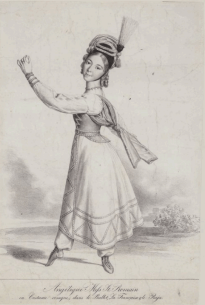
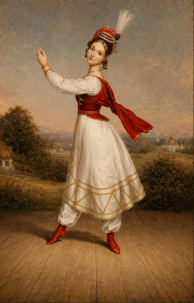
For general inspiration and details of posture and arms, I constantly kept in mind two images of the French danseuse Angélique Saint-Romain, who performed a Cossack dance in Vienna circa 1820. One Soviet character dance manual, talking about Ukrainian dance, says that these dances should be filled with a “playful sense of humor, and robust, high-spirited exuberance.” Our Cossack dance is meant to temper the the energy of Eastern European dance with the refinement of the French school. Our way of working is certainly novel, with one-on-one rehearsals in Paris followed by company rehearsals in New York, along with email and telephone exchanges, and zoom rehearsals. My hope is that the exuberance of the originals will come across in the spirit of the whole. 

Julia Bengtsson is presently rehearsing the Cossack Dance and other duets, solos, and quartets to dancers of the NYBDC, which will be performed May 10th in Dallas with the Dallas Bach Society… https://www.ticketdfw.com/event/homage-to-lafayette

Tempesta di Mare, performed on May 17:  https://tempestadimare.my.salesforce-sites.com/ticket/#/events/a0SVQ000002w10z2AA

and at the Berkeley Festival on June 12: https://www.berkeleyfestival.org/new-york-baroque-dance-company-music-of-the-regiment

To learn more about Louise Gervais and other pioneers of American dance, watch for Alan Jones’s forthcoming Substack,  Early Ballet USA.


Images Below: Angélique Saint-Romain in a Cossack dance in Vienna c. 1820. Period engraving, and re-imagined in color by ChatGPT.
Read Full Post »

An Open Letter to My Dancers

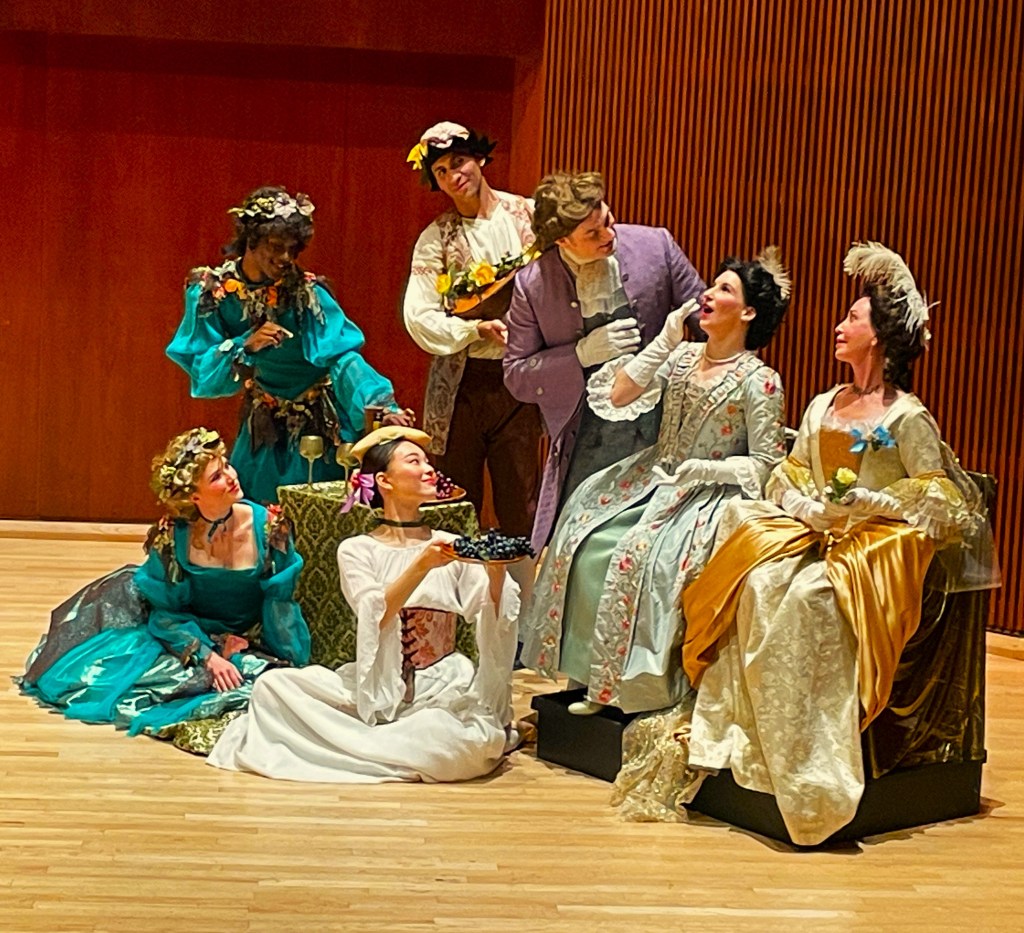
Clockwise from most left and on floor: Julia Bengtsson, Patrick Pride, Facundo Ferreyra, Brynat Beitman, Alexis Silver, Glenda Norcross and Kaede Hibara

Dear Dancers,

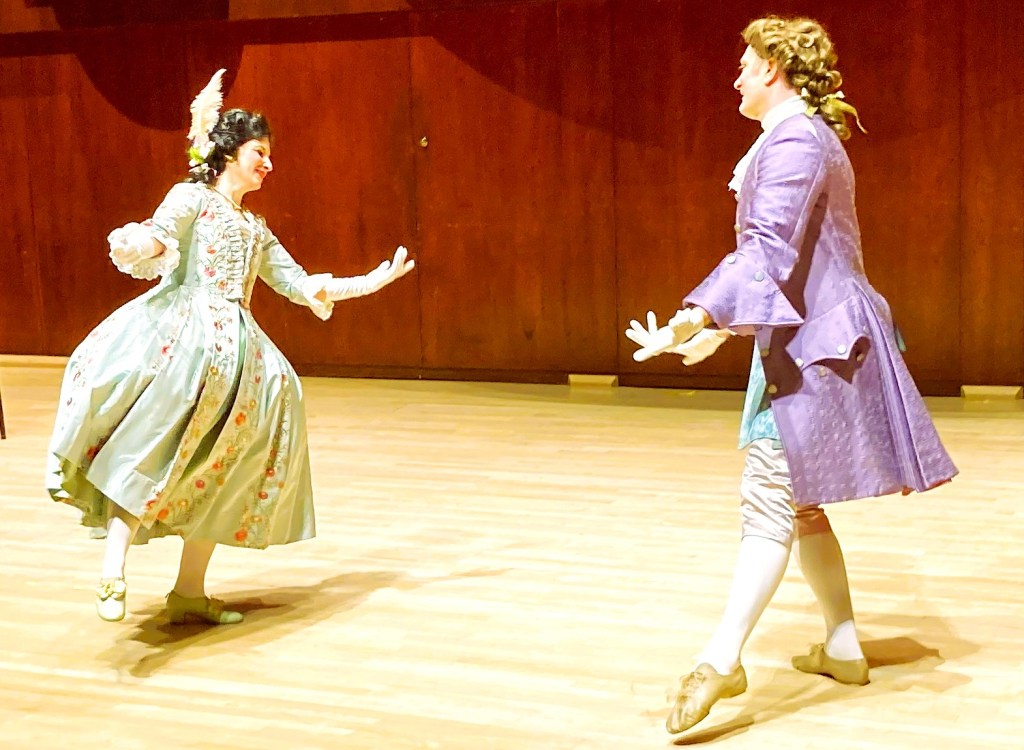
What a pleasure it was to see you perform on March 14th in Dallas, Nicolas Bernier’s Apollon, Comus et La Nuit. The work was unstaged, but then staged and choreographed once the dancers made their entrance. An audience member said he was enjoying the concert and, unexpectedly, it transformed into a ballet! From the first appearance of the court dancers, Alexis Silver and Brynt Beitman and the Duchesse du Maine, Glenda Norcross, the stage was filled with a noble presence. Reminding us of ballet’s beginnings, we saw the perfect carriage of the body joining the earth to the heavens, not stiff, but elongated and proportionately filling the kinesphere around each dancer. The solo Gravement danced by Brynt represented the virtuosic male solos of the time and was performed with vigor and detail. Alexis brought the female counterpart to the male virtuosity, displaying a delicate use of the arms, a polite façade with hints of passion in her demeanor and a graceful intelligence in her footwork. Glenda had a non-dancing role, but it could only be inhabited by a fine dancer emanating grace and beauty. You all helped to set the context of the drama, an entertainment for the Duchesse who never slept!

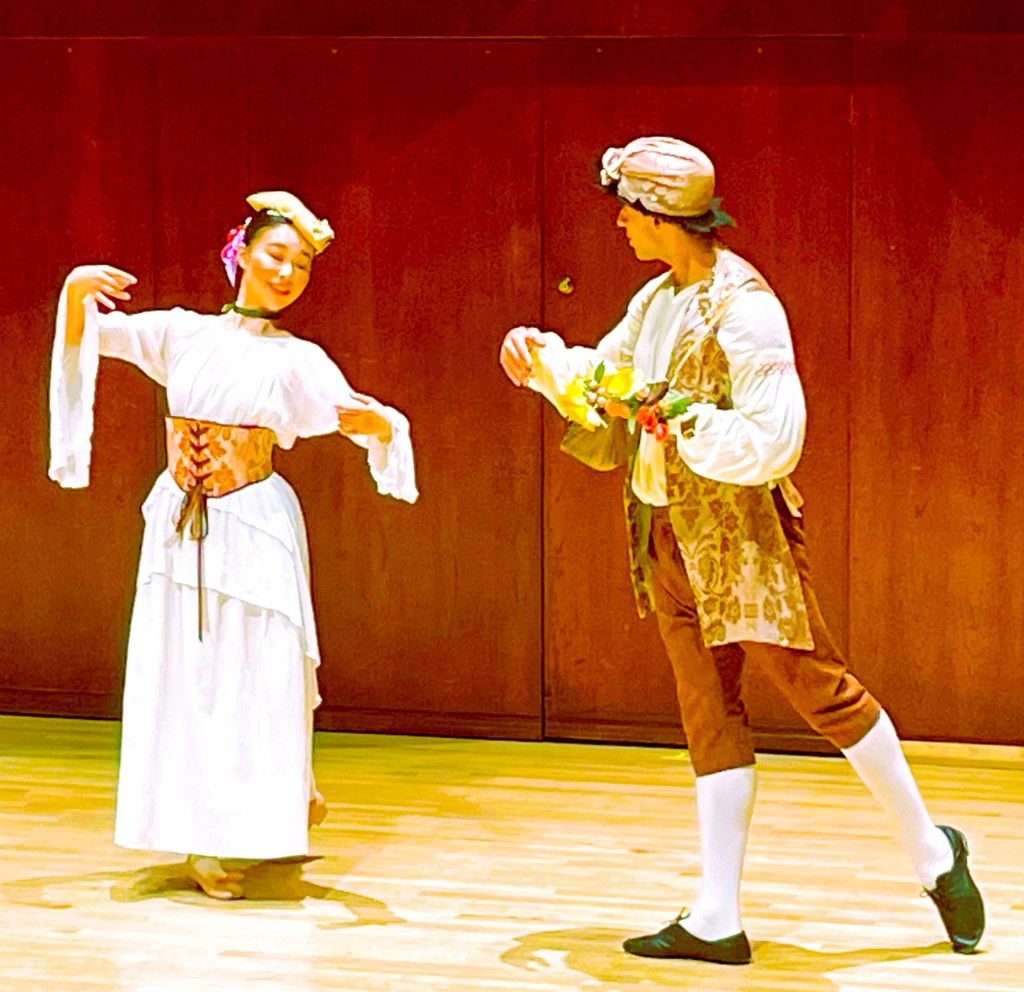
The entrance of the Arcadian shepherdess and shepherd, Kaede Hibara and Facundo Ferreyra, followed by rather inebriated friends of Bacchus, Julia Bengtsson and Patrick Pride, brought two contrasting elements together which are always present in a good ballet: Harmony versus Chaos. A member of the musicians said one only had to see Kaede take her place for the beginning of the Sarabande to know we were entering a Utopian world of nature and harmony. Facundo’s clever dance mixing folk steps, playing the mandolin and executing entrechat quatre was a precursor to character variations in ballet. He immediately hinted there would be a pursuit of the heart as he danced for both the audience and Kaede.

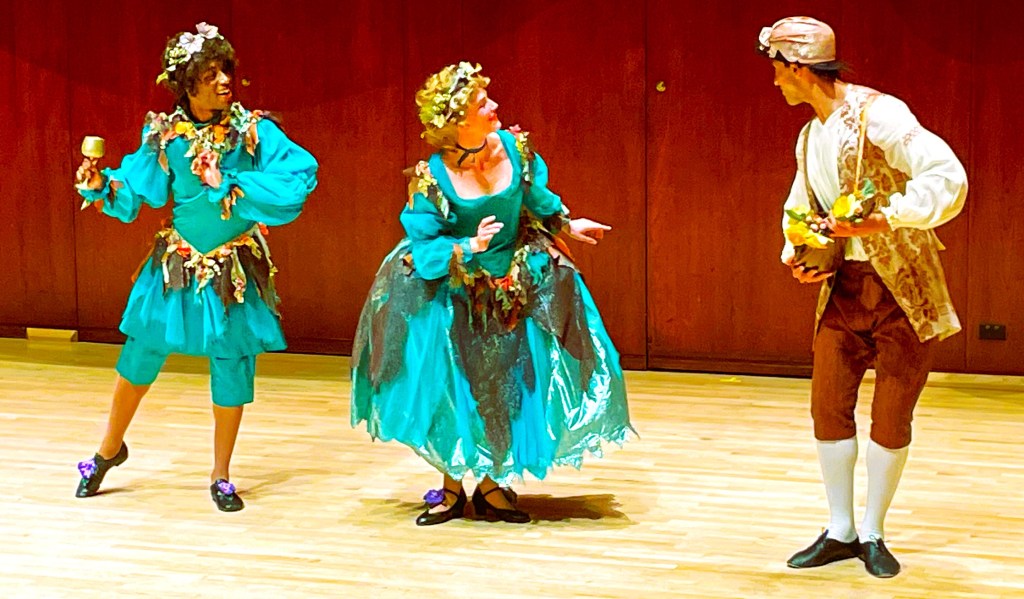
Patrick Pride and Julia Bengtsson would have pleased any fans of the Grotesque style or Commedia dell‘ Arte. Special skills such as musicality, rhythmic percussion, ease in dancing off balance and a deep love of zany characters are a “must” for dancers in this role. This type of dancing is rarely seen on the contemporary ballet stages of today and was a true surprise and delight to the audience. One member of the audience commented on Patrick’s unbounded sense of joy and whimsy. Another audience member mentioned Julia’s cartoon-like role with the innocence of a child crossed with the mischievous insistence of a leprechaun.

The choreography followed ballet theory of the time. After the fun and games were over the Arcadian shepherdess performed a solo musette, restoring order and classical beauty to the stage. This was followed by a tender musette minuet for the Arcadian couple which never ended as the couple held hands and continued walking in an intimate circle as if in a dream. The final trio chorus began and it was Julia who had to touch them to break their spell and join the other dancers in a minuet inspired by Mr. Shirley’s Minuet for Six dancers. The geometrical group minuets of the period typically referred to cosmic theory with the dance of the planets and indeed, the audience felt a sense of completion. One audience member asked, “When is the next performance?”  With two curtain calls and a standing ovation, we hope the answer is, “soon!”

Looking through the decades to when I choreographed this work in 1987 and performed it at NYU, and then Florence Gould Hall in 1988, I still see the original cast of dancers imprinting physical stamps on their dance characters. Luisa Meshekoff was the dance double of La Nuit and Ken Pierce was the dance double for Apollo. It was a courting rivalry which expressed their chemistry together and remains in the dances today. The comic timing and wit of James Martin as the original mandolin playing shepherd (thank you Alan Jones for the mandolin!) had a “rock star guitar playing” quality echoed by Roberto Lara who added his own sense of precision to the foot work in 2019. It seemed as if Facundo was able to blend these two qualities in his own performance. Miriam Cooper was the original shepherdess. I always admired her perfect ease and calm in pirouettes and for the musette she had a 3-measure pirouette with rises and a suspended flow. When Caroline Copeland danced this role in 2019 I completely changed the choreography to suit her strong points and again, this year, I created a new choreography for Kaede but I kept Miriam’s pirouette and the sustained flow of Caroline’s performance style. Kaede mastered both and added her own delicate grace. The followers of Bacchus in the original production were Thomas Baird, Patricia Beaman and a third character danced by Renouard Gee. The choreography has not changed a lot but it was changed from 3 dancers to two. The hemiola rhythms played with the same metal goblets, but different wooden plates, are a challenge. Fortunately, all 3 casts had a comic style of their own which truly shines in this choreography. Matthew Ting (2019) added a hemiola walk which I have kept. Julia and Patrick took naturally to these roles and I have been able to embellish the chaos thanks to their talents.

In conclusion, the choreography is affected by who is dancing the role. With each iteration of the ballet through the decades, it is already rich, but is further enhanced by the new performers. With each generation, the choreography gains another facet.

Observing this process over and over again since 1976, a half century, it has been a gift for me as a choreographer to witness what legacy means and to understand the legacy of embodiment as each dancer adds a quality or a step or a glance to the character they are playing…bringing even more grace, beauty and truth to the ballet.

James Richman, harpsichordist and conductor as well as the Music Director for the NYBDC over these 50 years, has enriched my knowledge of the French Baroque style. He directed our last performance with musicians from the Dallas Bach Society led by concert mistress Clare Cason. Matthieu Peyregne sang Apollo, Andrew Dittman sang Comus and Haley Sicking was La Nuit, all inspiring artists and we were honored to have them in the March 14th show. And last, but not least, a big thankyou to our new co-director, Julia Bengtsson, who helped to coach the new dancers!


Thank you to all!


Catherine Turocy

Alexis Silver and Brynt Beitman
Kaede Hibara and Facundo Ferreyra
Patrick Pride, Julia Bengtsson and Facundo Ferreyra

Photos compliments of Marci Hall

Read Full Post »